Helmet Shells
Back to all places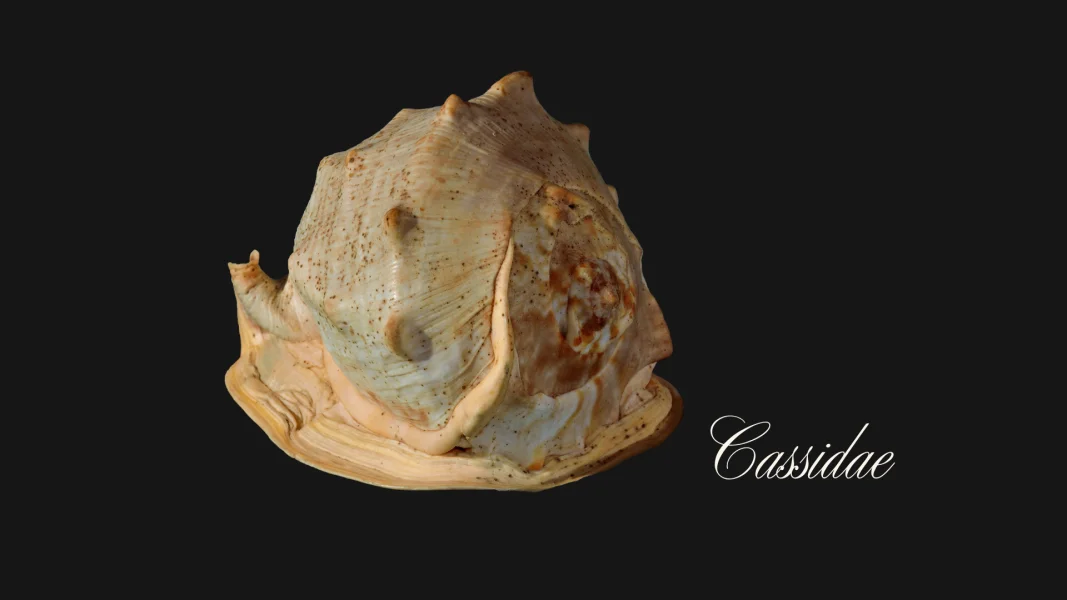
Bold, heavy, and beautifully patterned, helmet shells have long been treasured by humans – not to wear on the head, but to create art. The Cassidae family includes the great horned helmet (Cassis cornuta), the smooth king helmet (Cassis tuberosa), and others known for their thick, globular shells. These snails are burrowing predators on tropical seagrass beds and reefs, using their powerful, toothed radula to rasp into sea urchins and sand dollars. A horned helmet snail plowing through the sand is a fearsome sight for an unsuspecting sea urchin: the snail’s flared aperture covers its spiny prey, and spikes on the snail’s own shell provide defense (hence “horned” helmet). Ecologically, by eating urchins, helmets can help balance reef algae growth (fewer urchins can mean less grazing, though too few urchins might let algae overgrow – it’s a delicate equilibrium). The shells these snails carry are impressive – often the size of a grapefruit, with knobby “helmets” or frilled edges that inspired the common name. Ancient mariners likened them to the helmets of Greco-Roman warriors.
It was the cameo carvers of the 18th and 19th centuries who truly elevated helmet shells to fame.
They discovered that certain helmet shells, especially Cassis madagascariensis (bullmouth helmet) and Cassis rufa (red helmet), had ideal layers for carving: a contrast of pale peach and dark brown/coffee-colored strata. Artisans in Naples and Idar-Oberstein would cut cross-sections of these shells and intricately carve relief portraits, mythological scenes, and floral motifs, creating the coveted shell cameos of Victorian jewelry. Queen Victoria’s own penchant for cameo brooches popularized the trend, and soon helmet shells from the Caribbean and Indo-Pacific were being exported to Europe by the ton to satisfy demand. Many of the exquisite antique cameos we see in museums began as Cassis shells collected in places like Mozambique or Haiti, then transformed by Italian masters into miniature works of art. This merging of natural product and human skill gave the helmet shell a unique cultural footprint – even those unfamiliar with seashells may have seen a cameo pendant, not realizing it was once the “helmet” of a sea snail. In cameos, the helmet shell’s legacy endures as a canvas for human storytelling, much as its robust form once served the living snail as armor.
42.58135, 18.21556