Slit shells
Back to all places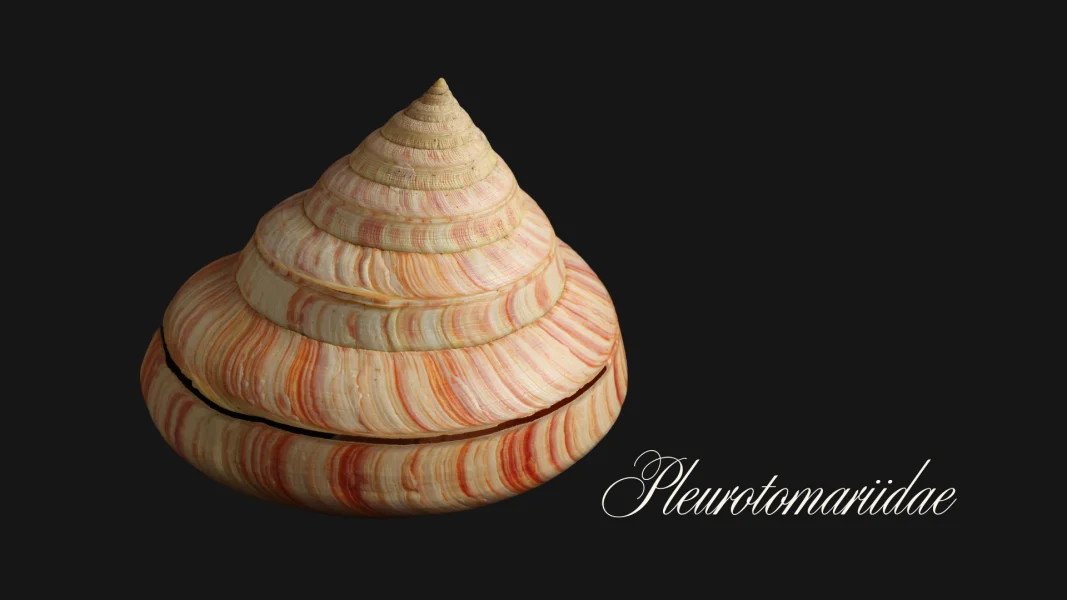
Once upon a time – over 100 million years ago – elegant coiled shells with a telltale slit adorned the ancient seas. These were the Pleurotomariidae, or slit shells, a lineage thought to have vanished with the dinosaurs... until one day in 1856, when fishermen dredged up a living “living fossil” from the deep
The discovery of a living slit shell snail astonished the scientific world: an animal known only from Cambrian to Cretaceous fossils was found alive in modern oceans
It was akin to finding a living dinosaur. Since then, about 15 species of slit shells have been identified, all living in deep waters, mostly beyond scuba depths
They carry beautifully whorled shells, often pinkish or pearly, each with a narrow slit or hole along the outer coil. Through this slit, the snail exudes water and waste – an ancient design to separate outgoing water from incoming, which modern snails accomplish with a notch or different anatomy.
These slit shells are sometimes called “marine jewels” because of their rarity and beauty. Species like the Imperial Red Slit Shell (Perotrochus) or the Green “Emperor’s” Slit Shell (Mikadotrochus) are prized by collectors and can fetch thousands of dollars for a single shell. In Japan, when the first Pleurotomaria was found in the 19th century, it was named “Mikado’s snail” (Emperor’s snail) and presented to the Emperor, symbolizing its preciousness. For a long time, only emperors and elite European museums had access to these curios. They became symbols of the deep sea’s mysteries – proof that not all ancient lineages perished. The Google Arts & Culture exhibit calls them “mystery of the slitsnails,” highlighting how they connect us directly to the distant past.
Biologically, slit shells are slow-moving algae grazers or sponges feeders on rocks. They live on deep reef walls or seamounts, creeping at depths of 100–800 meters (or more). Because sunlight doesn’t reach there, they often have subdued colors – pale pink, cream, or orange – though their form is graceful. They have a cap-like shell with a raised spire and that trademark slit. In the ecosystem, they are not abundant enough to be major players; rather, they indicate a healthy, undisturbed deep reef environment. Some have been found near undersea ridges and hydrothermal vents, adding to their intrigue.
Culturally, slit shells don’t feature in folklore simply because people didn’t know they existed until modern times. But in scientific circles, they are legendary. Every time a deep-sea expedition brings up a new species, malacologists (mollusk scientists) rejoice. They even named one species Perotrochus maureri after a diver who discovered it, immortalizing contributors to our knowledge. Conservation-wise, slit shells need protection by virtue of their habitat. Deep-sea trawling and dredging can easily smash these snails before we even know they’re there. Fortunately, many occur in very deep or rugged areas where fishing is minimal. However, as deep-sea mining for minerals looms, there is concern for all deep reef life.
The slit shells teach us the value of patience and wonder. A lineage that survived mass extinctions quietly persisted in refuges of the deep, only to be found by our curious species eons later. To stand in a museum and gaze at a slit shell is to travel in time. By safeguarding the dark depths they call home, we act as guardians of an ancient legacy. These snails remind us that the ocean still holds secrets, and some “lost” worlds may yet be found alive if we take care not to destroy them unwittingly
42.58289, 18.22075