Sundial Shells
Back to all places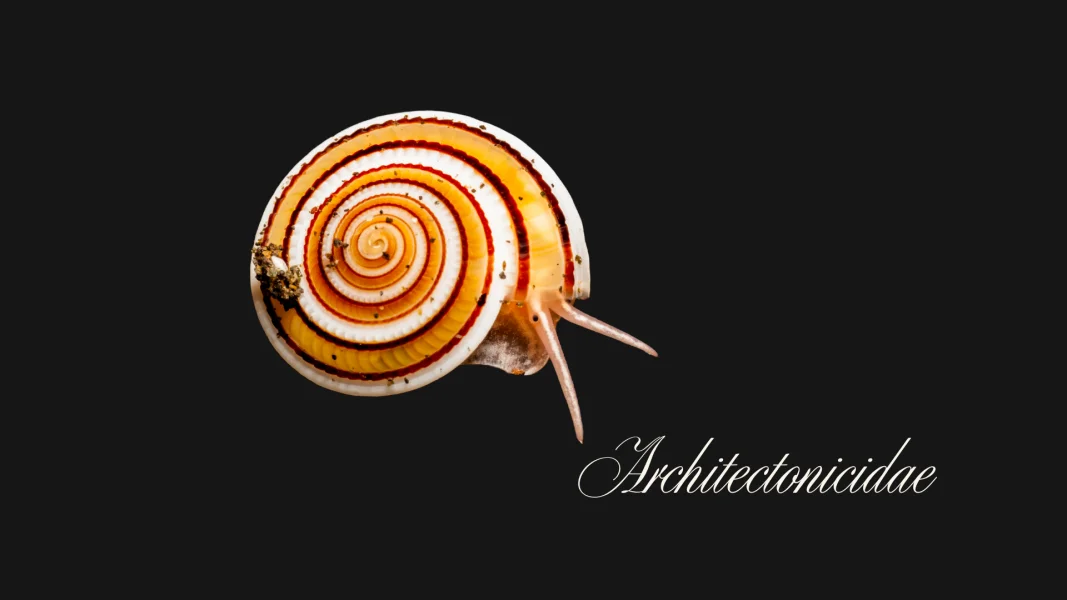
On the sandy shallows of tropical seas, one may encounter a shell that looks like a miniature mandala – perfectly flat-coiled and striped like a radial sunburst. These are the sundial shells (Architectonica spp.), members of a family whose name literally means “master of architecture.” The sundial snail’s flattened spiral is a natural marvel of symmetry: its whorls widen rapidly, forming a low cone with a brilliantly patterned top surface, often cream with chocolate or red spiral bands. Viewed from above, it indeed resembles an antique sun dial, with geometric markings that could mark hours. The snail that inhabits this artistry is a nocturnal predator, gliding over sand to feed on sea anemones and other sessile invertebrates. Equipped with a short siphon, it can detect prey buried nearby and then extend a proboscis to slurp soft-bodied anemones from their sand burrows. By day, the sundial snail often submerges itself just under the sand – perhaps to hide from predators like fishes, or to prevent overheating in sun-exposed flats.
Sundial shells have quietly influenced human mathematical curiosity. Their nearly perfect logarithmic spiral was noted by Victorian naturalists who were obsessed with the Fibonacci sequence in nature. Some early illustrators used Architectonica shells as examples of the “golden spiral” for teaching geometry, placing them alongside nautilus shells in textbooks to demonstrate natural logarithmic growth. The shell’s beauty also lent it a minor role in decorative arts: in the 1800s, sundial shells from the Philippines were sometimes inlaid into wooden furniture and snuff boxes, prized for their flat form that made them easy to set into surfaces. Collectors in the 19th century nicknamed them “Architect’s Eyes,” and indeed, a common species is Architectonica perspectiva – literally “perspective view,” as its spiral pattern draws the eye inward as if seeing into infinity. Such shells were often exchanged among enthusiasts in Europe as tokens of the exotic East where they were collected.
42.58234, 18.21499